Which products make money, after the returns they cause
A product's gross margin is a starting point. Its real contribution depends on how often it comes back — and a high-margin item with a forty per cent refusal rate can lose more money than a thin-margin item that always delivers.
Margin with RTO charged to the product that caused it
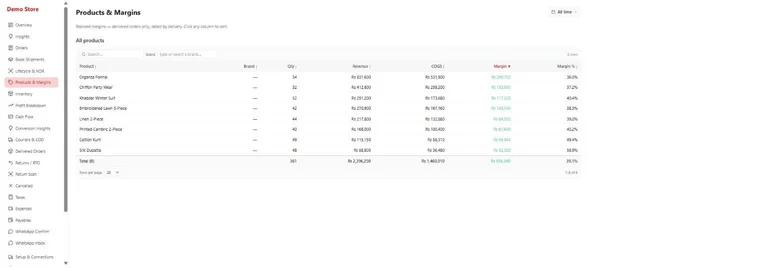
Kaarobar attributes the full round-trip cost of a returned parcel to the products inside it. That single change reorders most catalogues: the items at the top of a revenue ranking are often not the items at the top of a contribution ranking, and the gap between the two lists is where the pricing and merchandising decisions are.
- Contribution per product after cost of goods, freight both ways and packaging.
- RTO rate per product, so a refusal problem attaches to the thing causing it — usually sizing, or a photograph doing too much work.
- Products missing a cost price, listed explicitly rather than silently assumed to cost nothing.
Inventory, valued and aged
Stock is money that has already left your account. Kaarobar values inventory at cost and expresses cover in days of current sales, so slow stock reads as capital sitting still rather than as a healthy-looking quantity. Where stock data is unavailable for a product, cover reads as unknown — never as zero, which would misfile a whole catalogue as needing a reorder.
See it on your own orders — install freeQuestions merchants actually ask
- What if my Shopify products have no cost per item?
- Kaarobar lists every product missing a cost so you can fill the gaps, and tells you how much revenue is currently being measured against an unknown cost. It will not assume zero — that produces a flattering number and a false one.
- Does it handle variants?
- Yes. Costs, margins and stock are tracked at the variant level, because that is where cost per item lives in Shopify and where sizing-driven returns actually happen.