True net profit, with the formula shown
Every profit figure in Kaarobar can be opened line by line. That is deliberate: a number you cannot audit is a number you will not act on, and on cash on delivery the difference between the reported figure and the real one is most of the margin.
Why the Shopify number is not your profit
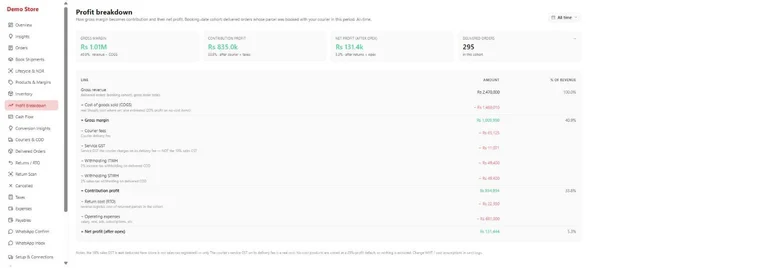
Shopify books revenue at the moment an order is placed. That is correct for a prepaid store and badly wrong for a COD one, where a large share of orders are refused at the door and come back. You never collect that money — but you already paid the forward freight, the return freight and the packaging on every one of them.
So a COD store reading its Shopify dashboard is reading gross demand, not income. Kaarobar starts from a different event: an order earns when it is delivered and the courier has remitted for it. Everything before that is a cost that has been incurred and a payment that has not arrived.
What comes off, in order
The same arithmetic runs in the free COD profit calculator — put your own five numbers in and watch the gap open, before you install anything.
The uncomfortable parts we did not hide
Missing cost prices are listed, not assumed
A margin is only ever as good as the cost per item in Shopify. The tempting shortcut is to treat a missing cost as zero, which produces a flattering number and a wrong one. Kaarobar instead lists every product with no cost price so you can fill the gaps, and tells you how much of your revenue is currently being measured against an unknown cost.
Returns are counted when they physically arrive
A parcel marked "returned" by the courier is not the same event as a parcel back on your shelf. Kaarobar keeps the two apart — see returns and RTO — because stock you have not received is not stock you can sell.
A recovery is not income
Courier payouts contain lines that look like revenue and are not; a balance payment, for example, is money being handed back to you, not a sale. Booking those as income overstates profit every month. They are classified as recoveries — see COD reconciliation.
See it on your own orders — install freeQuestions merchants actually ask
- Does it work if some of my orders are prepaid?
- Yes. Prepaid orders earn at the point of payment and carry no RTO risk, so they simply flow through the same ledger with fewer deductions. The COD-specific machinery — delivery gating, remittance matching, withholding — only applies to the COD orders.
- How far back does the profit history go?
- Kaarobar pulls order history well beyond the usual 60-day window, so your first profit figure is computed from months of real trading rather than a fortnight of it.
- What if I do not know my packaging cost per order?
- Enter an estimate and refine it. A stated assumption you can see and correct is worth more than an unstated one; the app shows the per-order figure being used everywhere it affects a result.